We provide crawlspace radon mitigation for homeowners in Asheville, Candler, Weaverville, Fairview, Black Mountain, and nearby Western North Carolina communities whose homes sit over vented, dirt-floor crawlspaces. Homeowners usually need this when a radon test comes back elevated and the house has no slab to work with — which describes an enormous share of the older bungalows, farmhouses, and mountain homes in this region. The fix is a sealed membrane system that stops soil gas beneath a liner and pulls it out before it reaches your floor.
Not sure if your crawlspace qualifies? Call anyway. “The house sits on a crawlspace and the test said 5.1” is a complete opening sentence.
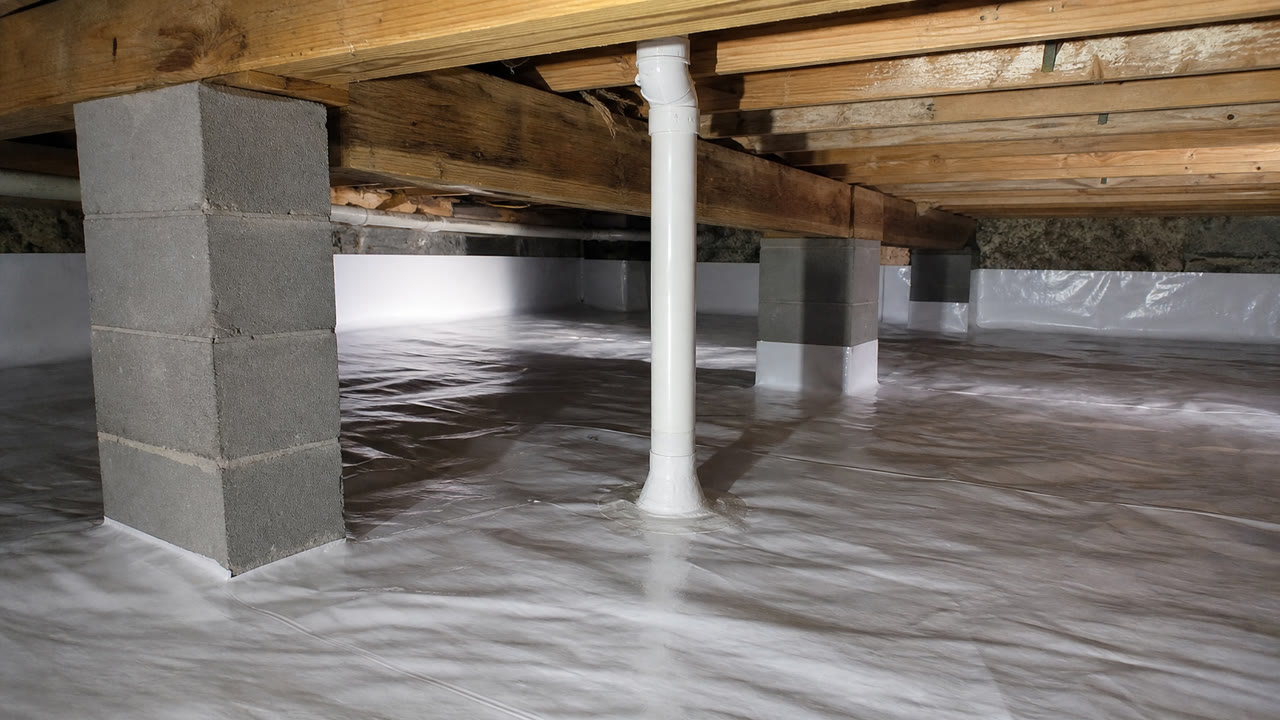
A crawlspace has no slab to depressurize, so the system builds its own barrier: a heavy plastic membrane is laid across the entire soil floor, sealed at the foundation walls, piers, and any penetrations. Perforated piping or a suction point goes beneath the liner, connected to an inline radon fan that vents above the roofline — the same fan-and-stack arrangement as a basement system. The technical name is sub-membrane depressurization. The effect is that soil gas collects under the liner and gets pulled outside instead of drifting up through your floor framing.
Done properly, the sealing is most of the labor. A liner with loose seams or unsealed piers leaks air, makes the fan work against the whole crawlspace volume, and underperforms. That sealing work is also why crawlspace scope varies more house to house than basement scope does.
The same triggers as any radon job — an elevated test during a purchase, a homeowner’s own kit reading 4.0 or higher, or a 2.0–3.9 result the family wants lower — with one regional twist: crawlspace homes around Asheville often surprise their owners. People assume radon is a basement problem, but a vented crawlspace is open soil sitting directly under the living space, separated from your bedroom by a subfloor and some insulation. Buncombe County’s Zone 1 geology doesn’t care which foundation type sits on top of it.
Three local realities stack up. First, the bedrock: uranium-bearing granite and gneiss under most of the county. Second, the construction era: large parts of Asheville’s housing stock — West Asheville bungalows, Fairview and Leicester farmhouses, older Black Mountain cottages — were built on open-vented crawlspaces with bare earth floors. Third, the stack effect: in heating season, warm air rising through the house actively pulls crawlspace air, and the soil gas in it, up through every gap in the floor. Foundation vents don’t solve this; on many houses they barely move the number.
The honest answer is: the crawlspace itself. Square footage drives membrane area. Clearance height drives labor — a three-foot crawlspace is a different job than an eighteen-inch one. Stored debris, old fallen insulation, or standing-moisture issues need handling before a liner can seal. Piers and interior footings add sealing detail. And combination homes — a crawlspace wing off a basement, the classic hillside layout — are usually solved with one fan serving both zones, which is more efficient than two systems but takes more design on the front end. The cost factors page covers how these translate into a quote. None of it is anything you need to measure or photograph before calling.
Not reliably. A standard encapsulation liner improves moisture and air quality, but without active suction beneath it, soil gas can still find seams and edges — and radon needs very little opening. Radon mitigation uses the same kind of membrane plus a fan depressurizing the space under it, then proves the result with a follow-up test. If your home is already encapsulated, that’s often a head start we can build on.
Usually, yes — low-clearance crawlspaces are normal in older WNC homes and they mostly affect labor time, not feasibility. Genuinely inaccessible sections are rare and we’ll identify them during scoping, not after.
Almost never. The typical solution is one properly sized fan with a suction point in the basement slab and a sub-membrane run in the crawlspace, joined into a single vent stack. It’s the most common combination job we see on sloped Asheville lots, and it’s exactly the kind of thing the first call sorts out.
Generally yes — a sealed liner with active suction under it also reduces ground moisture and musty crawlspace air migrating upward. It’s a side benefit rather than the design goal, but homeowners notice it.
Thirty seconds. We call back by phone — usually with a clear scope from that one call.
You don’t need to understand the report. The number is enough — for example, “inspection said 6.8” tells us almost everything we need to start.
That’s the most Western North Carolina radon problem there is, and it has a well-established fix. Call or send the form — the test number and “it’s on a crawlspace” is all we need to start.