We install radon mitigation systems for homeowners in Asheville, Arden, Fletcher, Weaverville, Black Mountain, and surrounding Buncombe County areas whose homes sit on basements or slab foundations. Homeowners usually need this after a test comes back at or above 4.0 pCi/L — often during a home purchase — or in the 2.0–3.9 range when they want the level lower. The goal is simple: a quiet, permanent system that pulls soil gas out from under the house before it can get in, verified by a follow-up test.
You don’t need to know any of the terminology below to call. The number on your report is enough.
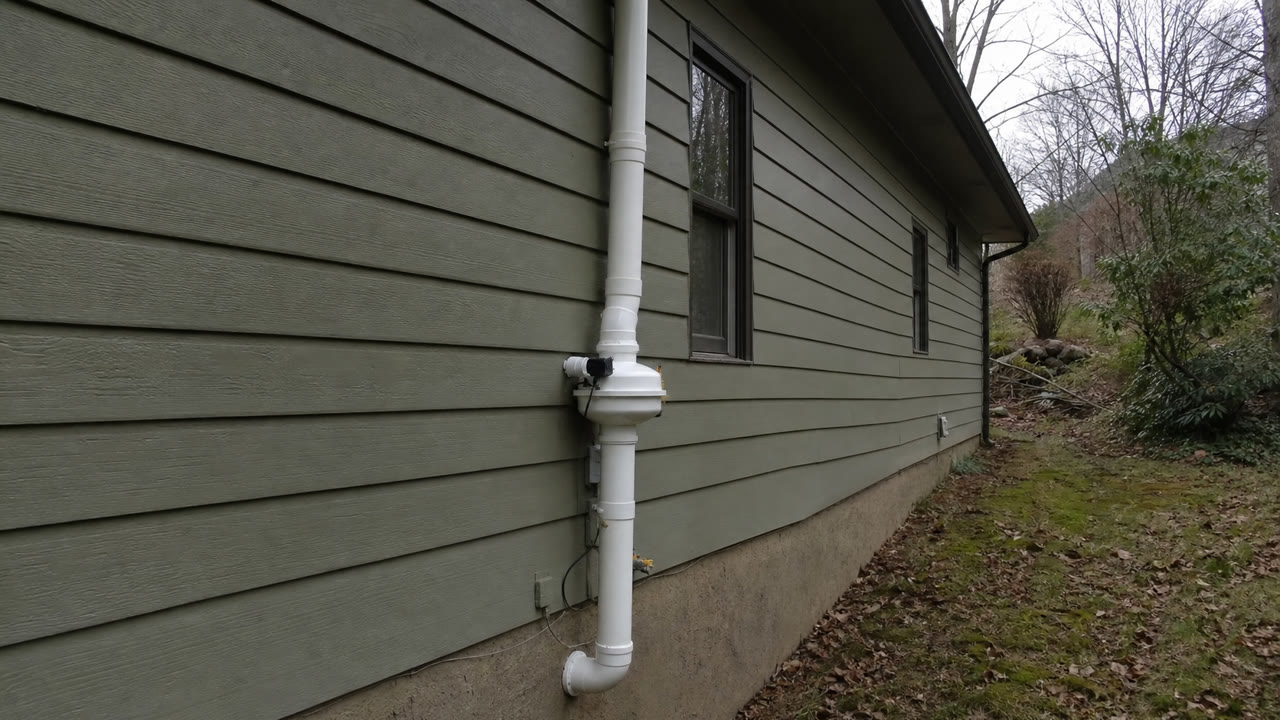
The standard system for basement and slab homes is called active sub-slab depressurization, and the idea is easier than the name. Radon enters because the air pressure under your slab pushes soil gas up through cracks, joints, sump pits, and utility penetrations. The system reverses that: a hole is cored through the slab, a small pit is excavated beneath it to create a suction field, and sealed PVC piping connects that point to an inline fan that runs continuously, pulling soil gas out and venting it above the roofline where it disperses harmlessly.
Along the way, the obvious entry points get sealed — slab cracks, the gap at the sump lid, open joints — so the fan’s suction works on the soil instead of pulling conditioned air out of your basement. A u-tube manometer goes on the pipe so you can verify at a glance, forever, that the system is pulling.
The trigger is almost always a test result. The common situations: a buyer’s inspection during due diligence came back elevated and the deal needs a fix; a homeowner’s own test kit or long-term monitor read at or above 4.0; a family is finishing a basement into living space and wants the level handled first; or a previous test in the 2.0–3.9 range has been nagging at someone who spends real hours in the lower level. Because Buncombe County is EPA Zone 1, none of these results are unusual — hillside homes with full basements have a lot of foundation in contact with gas-bearing soil.
The Blue Ridge sits on uranium-bearing granite and gneiss that steadily releases radon as it decays. Walk-out basements cut into a slope — an Asheville signature — put living space directly against that soil on multiple sides. Add the winter stack effect, where warm air rising through the house pulls soil gas up behind it, and an otherwise tight, well-built home can still test high. It’s geology, not a defect.
Most single-foundation homes get one suction point and one fan, installed in a day. The variables that move scope: how porous the material under your slab is (gravel pulls easily; packed clay or rock fill may need a second suction point), whether the home combines a basement with a crawlspace wing — very common on sloped lots, and usually handled by tying a crawlspace membrane run into the same fan — how far the pipe has to travel to a discreet exterior route, and whether the run can go up an attic and through the roof instead of along the siding. Fan sizing follows from all of that. The cost factors page walks through how each of these shows up in a quote.
You tell us the test result and answer a few plain questions: basement, slab, or both; rough size; sump or no sump.
Most basement and slab homes can be quoted from that call. Unusual layouts get a quick look first — we’ll say so up front.
Typically one day of work, then a follow-up test confirms the new level in writing.
Yes. Finished basements just change where the suction point goes — often a utility room, closet, or the garage side of the slab — so the visible footprint inside stays minimal. It’s one of the questions we cover on the first call, and it’s a routing decision, not a barrier.
The two common routes are up an exterior side wall — usually the least visible elevation of the house — or inside through a garage, closet chase, or attic and out through the roof. Sloped Asheville lots sometimes make one route clearly better than the other; we’ll talk through the options for your house rather than defaulting to one.
Most single-family installations are completed in one working day. Combination foundations or multi-suction-point systems can run longer, and we’ll tell you that in the quote rather than surprising you on install day.
Yes — the fan runs continuously, which is what keeps the pressure under the slab negative. Radon fans are small motors, comparable to running a light bulb or a bathroom fan, and they’re quiet enough that most owners stop hearing them within a week.
Thirty seconds. We call back by phone — usually with a clear scope from that one call.
You don’t need to understand the report. The number is enough — for example, “inspection said 6.8” tells us almost everything we need to start.
That’s the most common call we get, and the most routine fix in radon work. Call or send the form with the number — the rest is a short conversation.